

Reading this Article May Make You Laugh
Why “may” may be the most powerful word in scientific communication

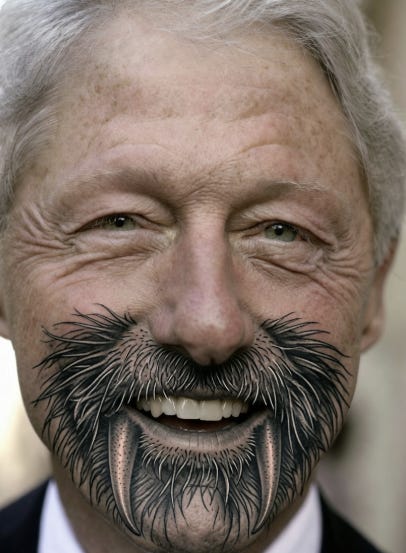
Bill Clinton may get a face tattoo of a walrus in the near future.
Yes, I just said that. He may get one.
But, I don’t think he actually will. If I were forced to put a number on it, I’d estimate the probability at considerably less than 0.000001%.
But notice something important: I didn’t say he will get a walrus face tattoo. I said he may get one.
So, technically, it is not a false statement. As far as I know, Bill Clinton has not publicly ruled out walrus-themed facial artwork. It’s theoretically possible that he could get one if he wanted to (or perhaps lost a very strange bet).
Likewise, Bono may announce tomorrow that he is opening a chain of Japanese-Mexican fusion restaurants called Where the Street Food Has No Name. Again, I find this highly unlikely. But it remains possible, and maybe this article even inspires him to do so.
Stick with me here, because these ridiculous claims have a lot more to do with scientific research than you might think.

Tentative Language in Science
Scientists are taught to be careful with language. Words like may, could, might, and possible convey a sense that conclusions are tentative, rather than definitive. (And we will also add can also deserves being on that list).
That’s generally a good thing, because science is messy.
Studies with a small sample size may give us initial insight, but then larger, more trustworthy studies may overturn the initial evidence. We may also realize that a finding that seemed convincing is more nuanced than originally thought – for example, a drug that seemed effective in the general population, is actually very effective in those with one genotype and harmful to those with a different genotype. Sometimes, we get false positive or false negative results by chance alone.
Better methods get developed, and new evidence emerges. Findings that once seemed convincing can later turn out to be incomplete, exaggerated, or simply wrong.
As a result, scientists learn to avoid words like:
always
never
guaranteed
impossible
Instead, we write things like:
These findings suggest...
This intervention may improve...
Our results might indicate...
Part of that tentative language is humility.
Part of it is recognition that science is supposed to be self-correcting (except when it’s not).
And, part of it is because many scientific findings genuinely deserve uncertainty.
The Probability Problem
Here’s what fascinates (and frustrates) me.
The word may does not carry a fixed probability.
If I proclaim:
Taylor Swift may be coming to my birthday party this year.
most readers interpret that as:
There is virtually no chance Taylor Swift is attending this guy’s birthday party.
Nobody hears that statement and thinks I should reserve an extra seat (or two, assuming Travis will join). So, a near-zero probability.
But if a university press release says:
or a news article says
Rising CO2 Could Be Altering Our Blood Chemistry, Study Suggests
or another one proclaiming:
Finger length could provide vital clue to understanding human brain evolution
many readers interpret may very differently.
Now may and could suddenly start behaving like: Scientists have found evidence that this is probably true. Perhaps the probability perceived here is upwards of 80%.
The same tentative language, but a completely different interpretation – one of evidence-backed confidence. In part, because the source seems reputable. If scientists have written those words in a peer-reviewed journal, or a university communications department has made a may- or could- or possible-based statement in a press-release, that gives these words some serious credibility. But, as a reminder, “peer reviewed” does not mean “perfect”.
No Accountability
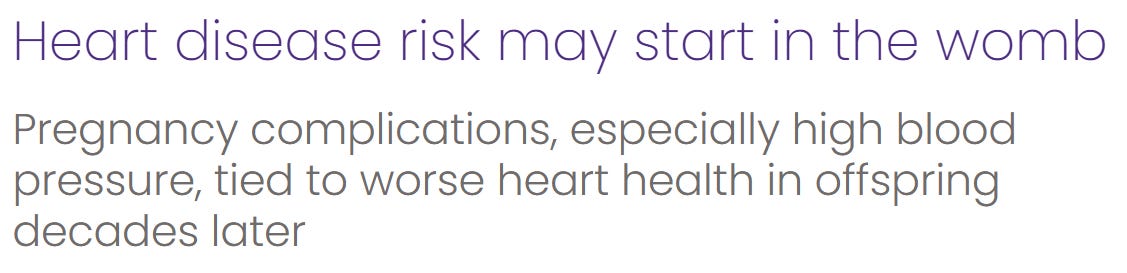
This became especially obvious to me while writing last week’s article about a university press release claiming that heart disease risk may start in the womb.
That’s certainly a plausible hypothesis, and there is some broader history of evidence to support it. But after reading the specific study behind the press release, I came away with a very different impression than the press release suggested.
The study measured tiny differences in surrogate vascular markers. It could not establish causality. It could not disentangle prenatal effects from genetics, shared family behaviors, socioeconomic factors, or environmental influences. Yet the public-facing narrative was clear: Heart disease risk may start in the womb.
If you only read the press release, you might think, “Gee whiz, that’s fascinating. Scientists have discovered where heart disease begins.”
If you read the paper itself, you might conclude: “This paper measures a bunch of stuff, but does not provide any real evidence to support the hypothesis that heart disease risk begins in utero.” At least, that’s what I did, and I wrote up my rationale here.
But here’s the tricky part.
If someone (like me) pushes back and says the evidence doesn’t support that conclusion, defenders can always respond:
We never said heart disease starts in the womb for sure. We just said it “may.”
And technically, they’re right. That headline below doesn’t boldly proclaim anything. It just suggests it, even if the study couldn’t possibly begin to answer that question. We’re the ones who decide how certain that “may” really is, and how it shapes our understanding of the world.
The Entire Spectrum of Evidence
This is where may and other tentative language becomes incredibly useful, and dangerous.
It allows dramatic scientific-sounding claims to spread socially as though they are likely true while preserving a layer of technical deniability.
The public often hears: probably.
The institution only said: possibly (without any magnitude of actual probability).
And those are very different things:
Sometimes the evidence supporting that may is extraordinarily strong.
Sometimes it’s based on a handful of observational associations, a surrogate endpoint, and a speculative mechanism… pretty weak evidence. (One example here)
Sometimes it’s based on a few correlations that are likely due to mathematical chance, that have only been arrived at following a zillion analyses attempting to find something statistically significant, combined with a bunch of internally inconsistent assumptions that are not supported anywhere in the literature… really, really weak evidence.
Sometimes it’s based on completely fabricated data. Yep, they literally made up a dataset Excel (which I highly suspect in this retraction)… or Photoshopped images to look like they did an experiment (see this example that I discovered and wrote about, and this one also). It happens. No evidence at all.
Yet the same word, may, gets used in all of those situations… and often interpreted as having the same fixed level of probability. “Scientists made an interesting discovery!”
In reality, the uncertainty behind one may can be radically different from the uncertainty behind another.
In some cases, the evidence supporting a scientific claim is extraordinarily robust.
In other cases, the claim may be no more likely to be true than Bill Clinton getting a walrus face tattoo.
And that is where it gets super-challenging. I am NOT claiming that all science commuication is untrustworthy, or that the probability that a claim is false is equal to unsubstantiated rumors, conjecture, conspiracy theories, or speculation.
Instead, I am arguing three things:
Trustworthy science exists alongside weak science, premature conclusions, and occasionally outright misconduct.
We often read scientific headlines and press releases with a default level of trust that causes us to interpret tentative language more confidently than we should.
Distinguishing between strong and weak evidence, as well as justified versus unjustified conclusions, often requires reading beyond the headline and examining the underlying methods, limitations, and assumptions — something most members of the public understandably lack the time or specialized training to do.
This Summary May Be Helpful
(see what I did there?)
So, my point is this.
The next time you read a scientific paper, press release, or interview and see the word may, could, possibly, might, or any other sort of tentative language, remember three things:
First, scientists are often trying to stay grounded and acknowledge uncertainty. That’s generally a good thing. Science is complicated, and humility is appropriate.
Second, these words may tells you almost nothing about the probability that a claim is actually true. A statement that is supported by decades of evidence and a statement supported by a single observational study can both be written using the exact same word.
Third, may creates a layer of rhetorical protection. A claim can spread socially as though it is likely true, but if challenged later, the author can always point out that they never claimed certainty in the first place. It’s our fault for misreading it as too definitive.
Once you start noticing this, you can’t unsee it.
Scientific communication is rooted in ambiguous qualifiers. They appear in peer-reviewed papers, university press releases, news articles, and interviews. Sometimes it reflects strong evidence. Sometimes it reflects speculation. Sometimes it reflects little more than an interesting idea.
So, the challenge for readers is that those situations often sound remarkably similar.
Next time you encounter a scientific claim containing the word may or any other hedging tersm, don’t automatically translate it into “probably true.”
Instead, ask a different question:
How much uncertainty is hiding behind that tentative word?
And the answer could possibly carry far more uncertainty than you may think.
I hope you enjoyed this article. If you did, please consider subscribing and restacking. Also, check out my other Substack newsletters (all are free, and never have any spam or sales).
Academic Life: Essays, reflections, and advice all about academia and higher education.
Human Limits: Sports science, sports medicine, and exercise training insight.
Everyday Culture: Sometimes serious, sometimes zany. A look at parts of our culture that made me think, and inspired me to write.
Also, I’d love to hear your thoughts on this article! Please feel free to comment below.
Just an odd observation from me
I don't know whether scientists got the "might"s and "may"s and "could"s rhetoric from lawyers or lawyers learned them from scientists or the propensity developed independently, but lawyers do exactly the same thing to deny certainty until it becomes second nature to them even in normal speech.
Both groups work with evidence, albeit very different kinds.
So are you saying I should get a walrus face tattoo?
Well framed. I have enjoyed this read.